More Than 45% of Texas-made aerospace and energy hardware now depend on CNC milling. This change has turned Houston a key player in high-accuracy manufacturing. Nearby producers and design engineers often prefer Houston-area providers to speed up delivery and verify quality on essential parts.
CNC Milling Houston
The following overview reviews Houston CNC milling and its manufacturing advantages. It outlines how local machining providers meet tight tolerances for diverse applications, from energy production to regulated medical components. Whether you need a CNC machine shop in Houston for one prototype or high-volume manufacturing, Houston supports many practical choices. Area manufacturers operate 3-, 4-, and 5-axis mills, live-tool turning centers, and electrical-discharge machining support.
Lowrance Machine’s team is a leading provider of close-tolerance machining in the area. Contact the team through www.lowrancemachine.com to outline your part specifications, materials, and production timing with a partner experienced in high-volume and high-precision projects.
Important Points
- CNC milling in Houston is important for Houston-area aerospace, energy, and biomedical supply systems.
- Houston machining services include advanced 3-, 4-, and 5-axis milling plus EDM support and turn/mill operations.
- Working with a nearby Houston CNC machine shop can shorten turnaround and improve communication.
- Lowrance Machine manages small-run and scalable production requirements with inspection-focused quality controls.
- Evaluate shops on available machinery, material knowledge, and capacity for scalable production.
Why Houston Has Become A Hub For Precision CNC Milling And Industrial Machining
Houston’s broad industrial base ensure a regular requirement for close-tolerance machined parts. Businesses across energy, petrochemical, aerospace, and medical markets depend on parts with precise fits and documented history. The local need creates opportunities for local machine shops to provide prototypes, assemblies, and repeat orders.
More than 6,000 manufacturers in the Houston area support a strong supplier base. Machining companies can coordinate with local specialty vendors for finishing, thermal processing, and quality checks. The local ecosystem reduces delivery delays, allowing rapid design iterations for high-detail components.
Houston remains a major base for energy-field hardware manufacturing, with direct access to pipeline infrastructure and the Port of Houston. Houston’s shipping and freight strengths make easier the delivery of oversized and heavy parts to domestic and international buyers. The transport network helps both one-off prototypes and full production programs.
The presence of Johnson Space Center and a strong aerospace cluster of 150-plus companies drive demand for aerospace hardware and testing fixtures. CNC Milling specialists in Houston handle consistent work in machining fixtures, aircraft brackets, and medical components. These projects demand controlled surface finishes and detailed documentation.
Houston’s industrial infrastructure supports larger machining programs in Houston. Proximity to suppliers of raw materials, toolmakers, and inspection labs shortens movement between process steps. This local advantage is critical for oil, gas, and life-science industries, where quick validation is often required.
Houston CNC Milling
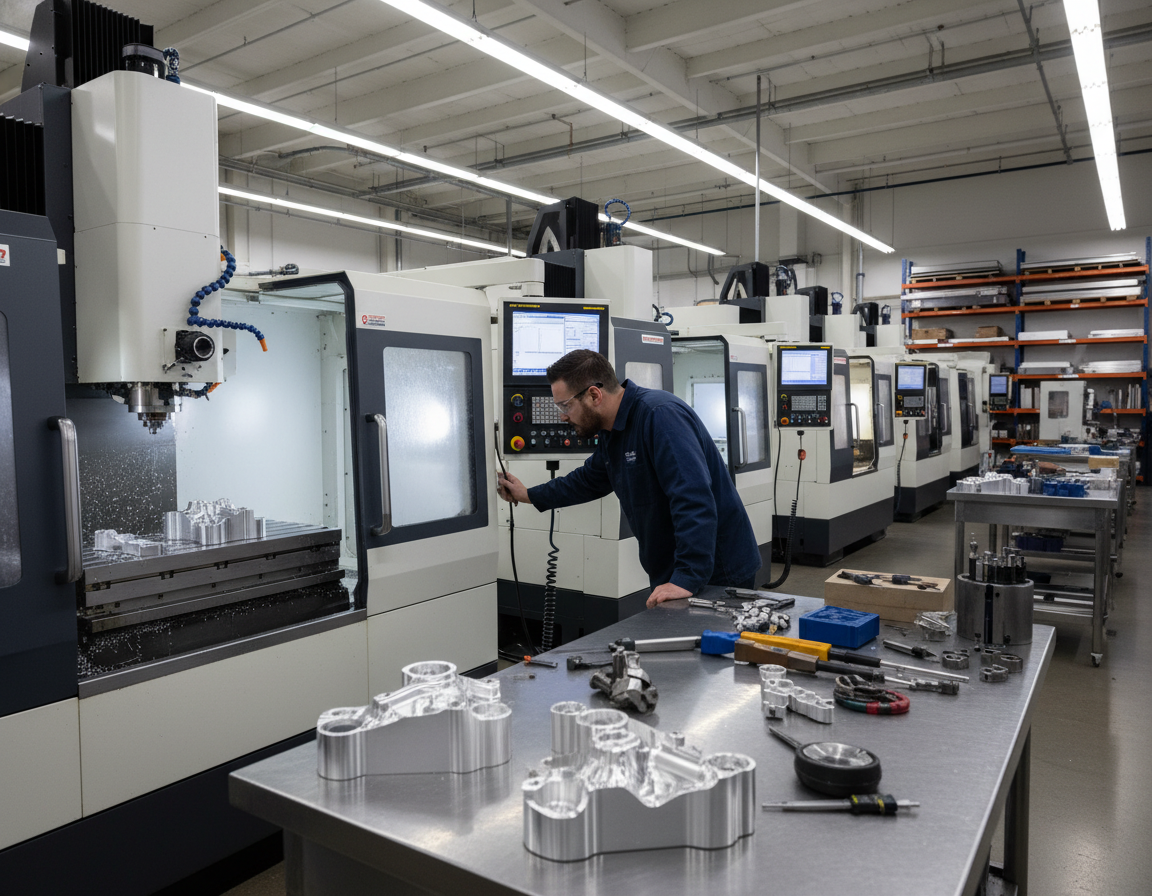
CNC milling converts CAD models into accurate metal and plastic components. The method depends on computer-controlled 3-, 4-, and 5-axis mills. Houston shops employ advanced toolpaths and high-RPM spindles to hold tight tolerances and smooth finishes. This is essential for aerospace parts, medical devices, energy hardware, and subsea components that require precision and fine detail.
Top-tier facilities pair multi-axis mills with rotary tables. The combined configuration allows for difficult profiles to be cut in a single operation. It cuts setup changes and reduces delivery schedules for prototypes and production runs. Turn/mill tooling and high-speed cutting allow shops to machine detailed features and small radii with repeatable accuracy.
Definition And Capabilities Of CNC Milling
CNC machining by milling applies precise digital motion to machine stock with precision end mills and cutters. Multi-axis control allows simultaneous movement on 3 to 5 axes. That makes possible the machining of deep pockets, angled faces, and undercut features in a single setup. CAM strategies like high-efficiency roughing and adaptive clearing enhance chip control and cutter life.
Many Houston precision shops work toward tolerances consistent with aerospace and medical standards. Close-tolerance machining uses thermal compensation, rigid spindles, and machine probing for in-process inspection. These features support parts achieve repeatable dimensions and stable geometry across batches.
Common Equipment And Capacity In Houston Machine Shops
Area CNC machining operations run machines from well-known builders such as Mazak, Haas, and DMG MORI. The DMG MORI NVX and NLVX series mills enable 4-axis work with rotary tables for mid-size and larger components. Larger machining-center investments help shops move from early prototypes to production volume.
Oversized machining platforms machine large and heavy parts for pressure-rated housings and offshore hardware. Capable providers invest in machines that hold accuracy on large parts, using heavy-duty tables and gantry structures. That capability keeps more large-part work in-house and keeps quality control local.
| Machining Capability | Common Hardware | Primary Benefit |
|---|---|---|
| Three-, four-, and five-axis milling | DMG MORI and Mazak multi-axis platforms | Complex parts with reduced setup time |
| Large-format machining | Large bridge mills and gantry systems | Controlled cutting for big workpieces |
| Live tooling & turning | Live-tool lathes and turn/mill centers | Fewer handoffs through combined turning and milling |
| High-speed spindles | High-speed spindle units | Cleaner finishes and quicker machining |
| On-machine probing | Renishaw probes, on-machine measurement | Fast checking of key features |
Related capabilities in a full-service CNC machine shop Houston include Houston CNC lathe machining for turned features and secondary operations. Using both turning and milling limits workpiece movement and compresses the complete production cycle.
Choosing a local provider with reliable equipment and multi-axis capacity supports tight engineering specifications and move projects forward faster. Good fixturing, optimized tooling, and modern machine tools create the core of reliable CNC milling in Houston.
Services Offered By Lowrance Machine For Precision Manufacturing
Lowrance Machine is focused on moving projects from prototype through production, with attention to precision, timely delivery, and documented quality. It offers a mix of automated CNC work and manual machining skill, supporting small batches, difficult components, and compliance-focused sectors. The operation pairs CNC automation and manual craftsmanship to satisfy tight tolerances and schedule demands.
Comprehensive CNC Milling And Machining Services
As an experienced machine shop Houston provider, Lowrance Machine offers CNC milling, turning, and assembly support. Its capabilities include multi-axis mill work, live-tool turning, and long-bed lathe work for extended parts. Electrical-discharge machining support enable precise internal features that are difficult to machine with standard cutters.
Gun drilling plus BTA drilling cover diameters from one-quarter inch through 3.75 inches and long lengths for deep-hole work. Internal value-added services include heat treating, plating, powder coating, and painting so components can arrive ready to assemble. These value-added finishing steps shorten turnaround and simplify supplier management.
Manual machining services in Houston are provided for one-off tools, fixtures, and short runs. Hands-on specialists handle fit checks, assembly adjustments, and custom modifications that support CNC output. This mix of automated and manual processes enables quick first articles and a cleaner move into production.
Certifications And Quality Systems
Quality at Lowrance Machine is built around traceable processes and robust inspection. The operation can combine CMM checks, SPC records, and probe EDM verification to help verify repeatability. These controls help customers in aerospace, medical, and industrial sectors that require inspection documentation.
Many Houston-area shops commonly point to AS9100D and ISO 9001:2015 to demonstrate their focus on controlled processes. Midway Machine provides one market example of a nearby machine shop holding AS9100D / ISO 9001:2015 certification, which reflects the quality expectations in the region. Lowrance Machine aligns processes to comparable industry expectations to help satisfy audit and compliance needs.
| Support Area | Capabilities | Customer Advantage |
|---|---|---|
| CNC Milling | 3- to 5-axis milling, high-speed spindles, hardened material strategies | Complex contours, tight tolerances, repeatable runs |
| Turn/Mill Support | extended turning, live-tool cutting, and multi-turret capacity | Less handling and stronger production efficiency |
| Wire EDM And Probe EDM | wire EDM plus probe EDM checking for internal geometry | Small-feature detail, clean finishes, and hardened-steel support |
| Deep-Hole Drilling | 0.25-inch to 3.75-inch gun/BTA drilling with long-length options | Accurate deep bores for functional parts |
| Manual Machining Services | Bench work, assembly fits, custom fixtures | Fast prototypes and practical adjustments |
| Measurement And Quality Assurance | coordinate measurement, SPC, probing, and inspection reports | Traceability for regulated industries, reduced rework |
| Finishing & Value-Add | heat treating, plating, powder coating, painting, and zinc phosphating | Simplified logistics with fewer outside vendors |
Choosing a partner that blends broad machining services Houston capabilities with tight quality controls reduces delivery delays and helps prevent production surprises. Lowrance Machine blends modern CNC machine shop Houston technology with hands-on manufacturing experience to serve prototype work, repeat production, and compliance-driven buyers.
Houston CNC Machine Shops: Materials And Industries Served
Houston machine shops work with a wide range of metallic materials and specialty plastics. Local providers handle strict tolerances and harsh environments. By pairing hands-on skill with CNC automation, they produce parts for both rugged sectors and high-accuracy markets.
Here’s a detailed look at frequently machined materials and the sectors using them.
Range Of Materials Machined
Carbon steels and alloy steels are widely used in energy projects, forming pressure housings and valve bodies. Stainless alloys is chosen for its corrosion resistance and cleanability.
Copper, bronze, brass, and aluminum are chosen for components needing conductivity, weight savings, and practical strength. Nickel-based materials withstand hot, corrosive, and demanding service environments in offshore and refinery applications.
PEEK, Delrin, UHMW, and other engineered plastics are used for parts needing low-friction movement and abrasion resistance. Such materials suit assemblies requiring lighter parts or chemical compatibility. Manual machining in Houston makes possible hand-finishing of soft and specialty materials, supporting the finished fit, finish, and function.
Industries Served And Example Applications
Energy companies need flow-control components, offshore hardware, and large housings. This work require rugged machining, straightness control, and complete inspection records.
Defense and aerospace customers request test fixtures, brackets, and flight-related hardware with high standards. CNC Milling in Houston helps achieve controlled GD&T requirements on complex aerospace parts.
Medical device and biomedical manufacturers need approved metals and engineered plastics. Regulated medical buyers often expect controlled cleaning and inspection processes. A qualified machine shop Houston partner helps with traceable lots and detailed records for regulatory compliance.
Marine, agricultural, and general industrial markets also depend on CNC machining. These sectors often require special fittings, pump hardware, and production tooling. The regional market’s broad material capability reflects regional demand, including steel grades, aluminum, copper-family alloys, nickel alloys, and specialty plastics. Such materials serve aerospace, biomedical, subsea, energy, marine, and agriculture applications.
Capabilities And Equipment That Improve Lead Time And Quality
Advanced Houston shops are revolutionizing lead times and part quality with modern equipment plus cleaner production flow. Fast multi-axis mills, heavy-duty horizontal centers, and extended-bed lathes remove production bottlenecks. The equipment mix, combined with on-site finishing plus metrology, delivers faster, more consistent results for customers across several markets.
Modern Milling And Turning Machines
High-speed 4-axis and 5-axis mills with rotary positioning enable engineers to create compound contours in one setup. That cuts cycle time and reduces alignment errors. These strengths are important to CNC milling in Houston supporting industries with tight tolerances.
Large horizontal machining centers, like the Okuma MB-8000H, support large, dense workpieces. These machines is designed for up to 4,400 lbs and include generous table sizes. This can mean a single run can consolidate work that might otherwise be split. Extended-bed turning in Houston is provided by lathes like the Okuma LB series, supporting long cylindrical components up to very long between-center lengths.
Live-tool turning equipment enables milling operations on turning centers. This reduces part handling, lowers cycle time, and limits alignment errors. Houston CNC lathe machining specialists apply live-tool capability to machine mixed-geometry parts in fewer operations.
Production Efficiency And In-House Finishing Options
Shop throughput improves when CNC Milling Houston equipment is supported by well-planned fixtures and tool-change automation. Automation such as pallets and gantry loaders keep machines cutting while technicians stage the next job. That creates higher throughput and predictable lead times.
Internal finishing services cuts outside queue delays. Frequently used services include thermal processing, coatings, powder coat, paint, and zinc phosphating. A one-stop model for machining services Houston allows customers to receive installation-ready assemblies without managing several outside suppliers.
| Equipment Capability | Representative Equipment | Practical Result |
|---|---|---|
| High-speed 5-axis milling | Haas and DMG Mori five-axis platforms | Complex shapes in single setup; superior surface finish |
| Heavy horizontal machining | Okuma MB-8000H | Fewer setups for heavy components |
| Long-part CNC turning | Doosan Puma and Okuma LB series | Efficient production of shafts and housings up to hundreds of inches |
| Live-tool lathes | Okuma LB 45 III with live tools | Fewer operations for mixed-feature parts |
| On-site finishing services | powder coat booths, plating lines, and heat-treat ovens | Reduced outsourcing and more predictable finish quality |
Selecting providers with this breadth of machinery shortens lead times and strengthens repeatable quality. For work that demands tight tolerances plus fast turnaround, partnering with shops that offer Houston CNC lathe machining, CNC Milling Houston, Houston machining services, and long-bed turning yields stronger schedule control and better product consistency.
Choosing The Right Machining Service In Houston: What To Look For
When choosing a provider, match technical capacity to the needs of the part. Verify the work envelope, load capacity, and axis count fit the job. This matters most with large or heavy items, where machines like long-bed lathes or large gantry mills are necessary. Confirm the vendor’s ability to perform multi-axis milling for difficult forms and live tooling for fewer-setup operations.
Next, assess the vendor’s experience with specific processes. Inquire about wire and probe EDM, gun/BTA deep-hole drilling, and manual machining services Houston for custom, difficult, or repair-focused assignments. A provider offering these services demonstrates versatility in both prototype and production environments.
Examine the quality systems and metrology equipment in place. Look for AS9100D or ISO 9001:2015 certification and CMMs, optical comparators, and calibrated gauges on site. A regional example such as Midway Machine’s AS9100D / ISO 9001 certification exemplifies high-level quality management in the Houston market.
Pay attention to the vendor’s communication speed and estimating accuracy. Fast and thorough estimates that outline tooling, setup times, and inspection steps suggest strong estimating and engineering capabilities. A provider that can begin with prototypes and grow into production indicates a stronger ongoing manufacturing partner.
Look for one-stop-shop services to compress schedules and reduce coordination costs. On-site heat treatment, plating, and finishing limit subcontractor delays and simplify logistics. This approach helps with keeping Houston CNC milling and other machining timelines on track.
Use a brief evaluation list to compare machine-shop capacity across vendors. Verify machine envelope, horsepower, and axis setup and whether they provide full Houston CNC machine shop capability plus Houston manual machining support for varied requirements.
Lastly, prioritize clear communication and traceability. Project updates, inspection records, and a defined contact person make complex jobs easier to manage. Selecting a Houston machine shop should feel like adding an engineering partner and not merely hiring a vendor.
Machine Shop Houston Project Cost, Lead Time, And Scalability
Understanding price and schedule is critical for buyers, engineers, and project managers. These factors come from material choice, part complexity, and required surface finish. Clear specifications are critical for reliable pricing.
Factors Affecting Price And Timing
The selected alloy or plastic strongly affects both cost and machining time. For example, aluminum machines faster than stainless steel, which can change tool wear and affect cycle time. Complex geometries and deep cavities also extend cycle time. Follow-up processes like anodizing or cryogenic deburring add days to lead time and add handling expense.
Volume significantly affects pricing. One prototype incurs programming, setup, and planning costs. In contrast, repeat batches distribute those costs over many parts. Larger production work can justify dedicated tooling and fixtures, shortening each production cycle. Clear CAD/CAM files and defined tolerances make estimates more accurate and help suppliers commit faster.
Moving From Prototype To Production
Moving machining from prototype to volume depends on stable machines and repeatable processes. Providers like Lowrance Machine invest in high-capacity mills and multi-axis machines. This investment supports quality during production ramp-up, reducing risk in moving from prototypes into production.
Cost-saving strategies include live-tool machining, better toolpaths, and purpose-built fixtures. Those methods decrease transfers and machining duration per component. Choosing alloys and finishing processes that reduce secondary steps can lower total cost. CNC Milling Houston capabilities, when planned well, can reduce extra machining steps by machining more features at once.
Price estimates and delivery promises are strengthened by accurate project details. Supply accurate CAD and CAM data, clear tolerance callouts, and acceptance of suggested process optimizations. Good communication with a shop reduces back-and-forth, creating more predictable delivery and cost outcomes.
| Driver | Effect On Price | Effect On Schedule | Mitigation |
|---|---|---|---|
| Material choice, such as aluminum vs stainless | Aluminum lower; stainless higher due to tool wear | Stainless can lengthen cycle time | Review alternate materials that meet function but cut faster |
| Component complexity and features | More complex raises programming and run cost | Complex features can add production time | Use multi-axis CNC Milling Houston and consolidate setups |
| Tolerance and surface-finish requirements | Tight tolerances increase inspection and rework costs | Precision work requires slower cycles and more QA time | Specify only the tight tolerances and finishes the part truly needs |
| Order volume | More parts can lower per-piece price through amortization | Bigger runs may need more fixture prep but reduce each-part time | Group quantities to take advantage of tooling amortization |
| Additional processing steps | Heat treat and plating can add outside-vendor costs | Every outside process can add queue and transit time | Select material/process combos that reduce secondary steps |
| CAM and fixture optimization | Improved processes reduce run time and expense | Better processes shorten machining cycles | Use machining services Houston expertise to improve CAM and fixturing |
Conclusion
The Houston manufacturing market is a strong fit for CNC Milling Houston projects needing accuracy and quick turnaround. Area machine shops invest in top-notch equipment from brands like major builders such as DMG MORI and Okuma. These shops may also support long-bed lathes, live tooling, EDM, and in-house finishing. The combined equipment base makes possible smoother progress from first article to repeat manufacturing.
As you select a CNC machine shop in Houston, compare part requirements, volumes, and QA plans. Ask about certifications like recognized standards such as ISO 9001 and AS9100D. Detailed quotes and honest schedule estimates are key to avoiding delays. They help ensure the chosen shop can scale with your project.
For Houston machining services that include finishing and assembly, evaluate the whole workflow and the shop’s communication. The Lowrance Machine team supports the entire prototype-to-production workflow. The team provides capability reviews and project quotes to support your dimensional needs and schedule goals.